
A Sapiens field story · Gaza
A fisherman keeps casting his nets as hunger gains remain fragile
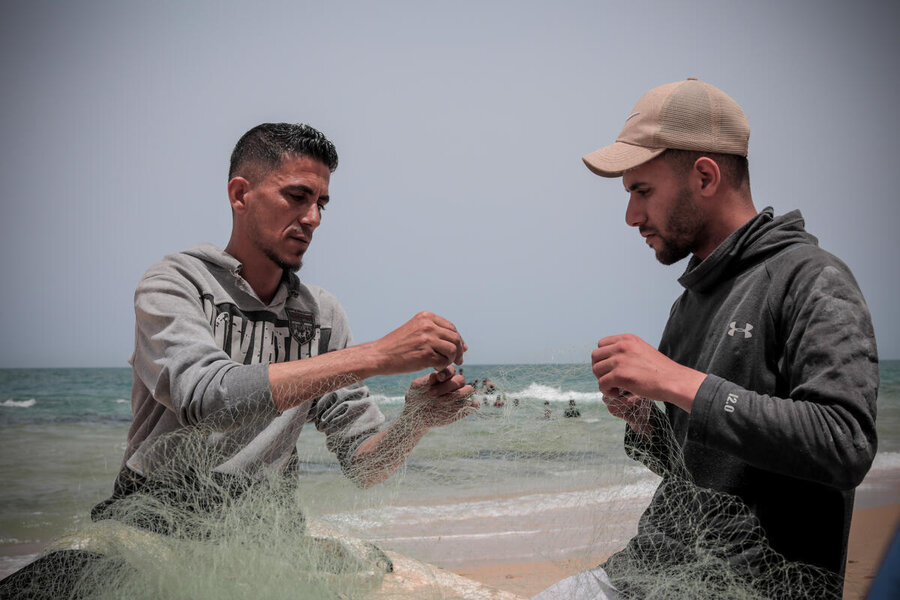
For Murad al-Aqra, the sea is livelihood, risk and one of the few remaining ways to keep seven children fed.
The fuller story
Murad al-Aqra risks going to sea to feed his family. WFP reports that expanded aid has helped, but restricted access and funding gaps could quickly reverse progress.
This is an original Sapiens narrative built from the credited reporting. It stays close to the documented people, places and facts while adding the context needed to understand why the story matters.
Keep the original source beside youA life tied to the sea
The nets come back almost empty.
Murad al-Aqra lives in Deir al-Balah and supports a family of nine. WFP’s account follows him to the shoreline, where a day’s catch may be only one or two kilograms and each trip carries danger.
Fishing is not presented as a symbol detached from daily life. It is work, food and responsibility at a time when other sources of income and care have been stripped away.
A narrow improvement
More aid has helped, but survival is not recovery.
WFP reported modest improvements in food security after humanitarian and commercial supplies increased. Yet 1.4 million people still faced crisis or worse hunger, and roughly 200,000 remained at emergency levels in the July analysis.
Food parcels, hot meals, bread and cash reach al-Aqra’s family and many others. The support keeps people alive, but it does not restore the health care, education, water, safety and livelihoods families say they need.
What could be lost
Any interruption can reverse the gains.
Restricted crossings, insecurity and funding shortages keep the food system precarious. WFP warns that ration cuts or a break in access can push households back toward catastrophic hunger with little warning.
The story stays with one fisherman because scale can hide what fragility means. For al-Aqra, it means continuing to cast a net even when the sea yields little, because his children are waiting on shore.
Health inside hunger
Food cannot be separated from medicine, water or shelter.
Al-Aqra’s family carries needs that a food parcel alone cannot resolve. One daughter requires regular care for kidney disease, treatment that became difficult to obtain after the war began. His youngest child became severely ill and later recovered with nutrition support and treatment. These experiences show how quickly hunger compounds an already fragile medical condition.
A household can receive calories and still lack safe water, sanitation, medicine, transport or a functioning clinic. That is why a modest improvement in food-security classification should not be mistaken for a return to ordinary life. Survival remains dependent on multiple systems holding at once.
Another family’s memory
Displacement continues after the journey stops.
WFP’s reporting also follows Inas Al Qombuz, a software-engineering student and pregnant mother who was displaced repeatedly after leaving her home east of Gaza City. Nutrition support, food parcels and cash helped her health improve, but her family continued living in a tent, collecting water from trucks and cooking over an open fire.
Her account widens the story beyond a single shoreline. Displacement is not only the moment of leaving; it is the accumulation of interrupted study, lost work, improvised shelter, scarce produce and repeated decisions about where a family might be safer. Even after food becomes somewhat more available, the effects of malnutrition and uprooting remain.
The meaning of fragile
A better number can still describe an unbearable life.
Food-security analysis helps show whether conditions are improving or deteriorating across a population. In July, the direction had improved modestly. But behind that movement were families still relying on assistance, markets where nutritious food remained unaffordable and operations vulnerable to a closed crossing, an unsafe route or a funding gap.
The final image is not recovery completed. It is al-Aqra repairing his net beside the Mediterranean and continuing to work with what remains. The sea is livelihood and danger at once. His persistence should not be used to romanticize deprivation; it should clarify how much responsibility families are carrying while the systems around them remain broken.