
A Sapiens field story · Somalia
She gives the water to the children first
Outside Dhahar, a mother of nine keeps a little water moving through her family while the clinic treating her youngest daughter faces a funding cutoff.
The fuller story
CARE reporter Sarah Easter met Aisha, her one-year-old daughter Shukri and the health worker who brought them into care. Their story shows how a dry borehole, a debt book and a clinic's funding can meet inside one household.
This is an original Sapiens narrative built from the credited reporting. It stays close to the documented people, places and facts while adding the context needed to understand why the story matters.
Keep the original source beside youThe first cup
By the time water reaches the shelter, the children are waiting.
Aisha lives with her nine children in a displacement camp outside Dhahar. When CARE reporter Sarah Easter visited, the main borehole had already run dry. Water arrived by tanker and was stored for sale. Aisha could take a container on credit, but every refill made another entry in a notebook that would have to be settled later.
She carried a yellow container home and the children gathered. They drank; children from neighbouring shelters came too. Aisha shared what she had and, at that point in the day, had not yet had any herself. It is tempting to call such a moment extraordinary. For the family, it was the practical work of getting through an afternoon.
A price for water
The distance to water is only part of the journey.
A truck can reach a camp and still leave a family without enough to drink. When a borehole fails, the cost of water moves into budgets already stretched by food, shelter and illness. Aisha's household had to borrow for something no child can wait to receive. The debt book at the water point is a small record of a much larger drought.
The children also need meals. Three of Aisha's sons, aged seven, nine and eleven in CARE's account, went into town to shine shoes. On a good day their work brought home enough for rice and a few tomatoes; on other days it brought nothing. Aisha has diabetes, making long stretches without regular food especially dangerous. Yet the order inside the household remained familiar to her: the children ate first.
A visitor at the door
A health worker noticed what hunger had done to Shukri.
Saytuun, a CARE community health worker, visited the camp and screened children under five. A coloured measuring tape around Shukri's upper arm indicated severe acute malnutrition. The one-year-old also had a fever and cough. Saytuun directed Aisha to a CARE health centre in Dhahar where treatment was free.
That chain of care looks simple when written down: a worker visits, a child is screened, a clinic treats her. Each link is a real person or a service that has to keep operating. Aisha had to know that the visit would cost nothing and that someone would be there when she arrived. Shukri needed therapeutic food, medical attention and a way to return for follow-up. The small tape mattered because it connected concern at home with treatment before more time was lost.
The clinic's future
The place Shukri reached was itself in danger of closing.
CARE reported on 30 September that its Dhahar health centre was one of eleven facilities in the region expected to close in October because of funding cuts. The account documented a risk and a deadline; Sapiens has not independently confirmed which facilities ultimately closed. Across Somalia, CARE said dozens of its supported health centres had already shut during 2026.
When a clinic closes, distance changes. Treatment that was free and familiar becomes another journey, another fare, another day away from the work that pays for food. For a child recovering from malnutrition, continuity is not an administrative detail. It is the difference between a first visit and a treatment that has a chance to hold.
A life beyond the numbers
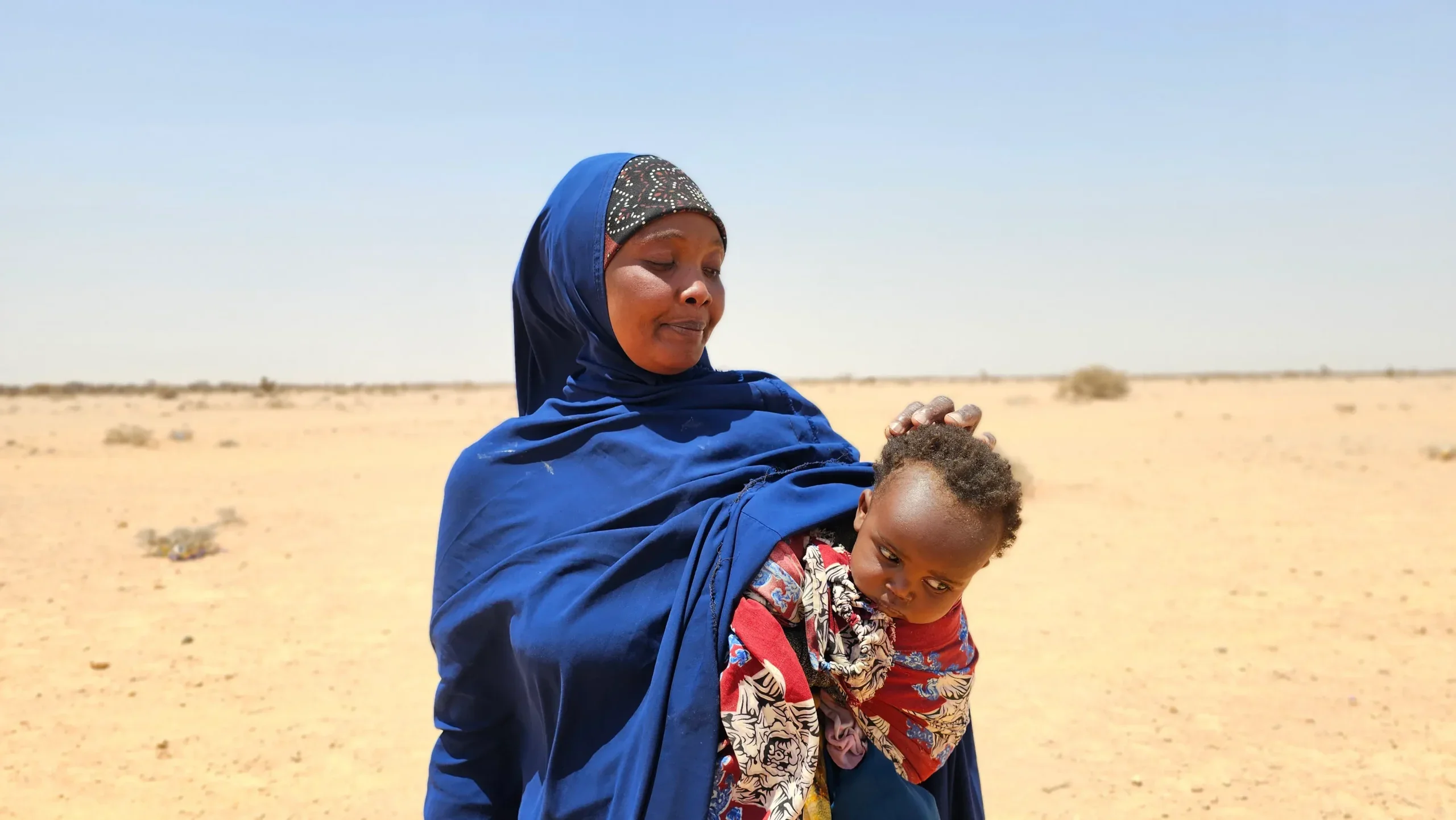
The photograph asks us to see a mother and child, not a symbol.
Sarah Easter's photograph shows Aisha holding Shukri in open daylight. They are not anonymous figures chosen to stand for a country. They are two people CARE met, with a specific route to water, a specific health worker and a clinic whose future was uncertain at the time of reporting. Their names and circumstances belong to them.
Aisha has already carried her family through violence and displacement. The current emergency is quieter in the frame: a dry water point, children's meals bought with small earnings, a baby who needs treatment, a mother who waits to drink. Better funding cannot undo everything that brought them to Dhahar. It can keep a health worker visiting, a treatment centre open and water within reach without asking Aisha to borrow for the next cup.