
A Sapiens field story · Bangladesh
Amin brings the first signs of care to the door
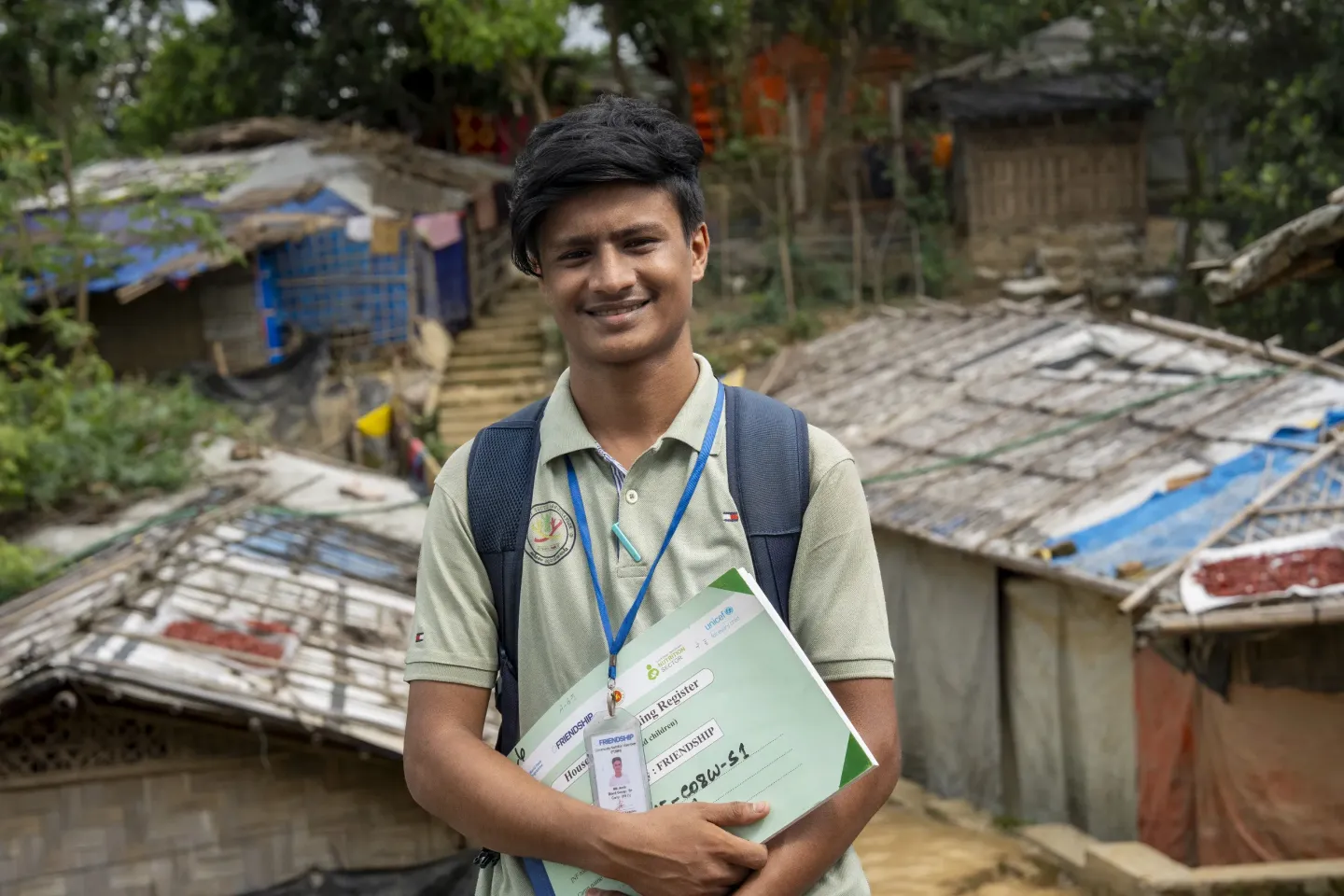
Mohammad Amin arrived in Bangladesh as a displaced child. At twenty-two, he now walks the lanes of the Rohingya camps so families do not have to face a child’s illness alone.
The fuller story
In Cox’s Bazar, more than 760 Rohingya nutrition volunteers visit homes, screen children and help caregivers reach treatment early. Amin’s work is practical and deeply personal: care delivered in a familiar language by someone who knows what displacement asks of a family.
This is an original Sapiens narrative built from the credited reporting. It stays close to the documented people, places and facts while adding the context needed to understand why the story matters.
Keep the original source beside youA path back to the door
Amin was thirteen when displacement changed the shape of his childhood.
Mohammad Amin fled Myanmar with his family and arrived in Bangladesh at thirteen. Nine years later, the lanes of the Rohingya refugee camps are not only the place where he lives. They are the route of his work: household after household, child after child, asking careful questions before illness becomes an emergency.
The work carries a quiet kind of recognition. Amin knows the uncertainty families are living with because he has lived it too. When he steps through a doorway, he is not arriving as a distant expert. He is a neighbour trained to notice the first signs that a child needs more help.
The morning round
Nutrition care begins with a conversation in a language a caregiver trusts.
Community nutrition volunteers usually move in mixed-gender pairs, allowing them to speak comfortably with different members of a household. A pair may visit fifty or sixty homes in a day and about five hundred in a month. They ask about eating, illness and growth, screen young children and explain where treatment is available.
The repetition is the point. A single campaign can raise awareness; a familiar person returning to the same lane can notice change. Volunteers help turn a large humanitarian programme into something a parent can use at the exact moment concern begins.
A child named Shahed
Recovery was visible in a measurement, and in a child beginning to feel like himself again.
UNICEF’s account follows one of the children reached through this network: thirty-one-month-old Shahed. Screening identified that he needed care. With referral, treatment and follow-up, his mid-upper-arm circumference later reached fourteen centimetres, a small number carrying the weight of meals tolerated, strength returning and a family breathing differently.
No measurement tells the whole story of a child. It does, however, help a volunteer act before weakness becomes crisis. The tape around an arm is useful because it connects observation to a clear path of care.
Trust is part of the system
A clinic can be close on a map and still feel far from a frightened parent.
Referral only works when families understand why it matters and believe they will be treated with dignity. Volunteers translate more than language. They explain unfamiliar processes, answer ordinary questions and help caregivers move through a system that can feel difficult from the outside.
Across the camps, more than 760 volunteers help connect roughly 174,000 children under five with monthly nutrition screening and care. The scale is large, but its strength is intimate: someone recognises a family, returns and remembers what happened after the last visit.
Work with meaning
For Amin, helping a child recover has also created a way to serve the community that raised him.
Displacement often narrows the choices available to young people just as they are deciding who they want to become. Community work does not resolve that larger injustice. It can still create responsibility, skill and a place in the life around them.
Amin’s knowledge is both learned and lived. Training taught him how to screen and refer. Experience taught him how easily a family can feel overlooked. Together, those forms of knowledge make him part of the health infrastructure of the camp.
What keeps the work alive
The most moving part of this story is also the most practical: care has to return tomorrow.
A nutrition programme needs supplies, trained staff, treatment space, clean water and reliable funding. It also needs people willing to walk the same routes again. When budgets shrink, the loss is not only a line item. It is a missed visit, a delayed referral and a caregiver left to decide alone whether a child is sick enough to seek help.
Amin’s rounds show what sustained humanitarian care can look like when it is built with a community rather than simply delivered to one. The work is not dramatic from the outside. A knock, a greeting, a strip of measuring tape, a conversation. For one family, it can be the beginning of recovery.